Showing posts with label King Siallagan. Show all posts

Tuesday, January 03, 2012

Indonesia -- Day 5 Touring Simanindo on Samosir Island, Sumatra


We continued on from the Stone Chair of King Siallagan in Ambarita to the village of Simanindo to see a Traditional Batak Spiritual Dance.  Simanindo is approx 15 km from Tuk Tuk. 

While this dance was lovely and calm in its delivery, I am not sure if its the most riveting dance performance I have ever seen.  It is quite slow and delicate.  There is audience participation promoted near the end and of course the requiste "donation" box.

A quote from Footprint Travel Guides describes it perfectly:

Close by is a well-preserved fortified Batak community, with fine examples of richly carved Batak houses. This is the best maintained of the various 'preserved' communities on Samosir. Visitors sit through a lengthy sequence of 12 dances, performed by a rather lacklustre crew - many of the dances seem more like loosening up exercises prior to a workout. Requisite audience participation number and the final dance gives an opportunity for guests to add a donation to their entrance fee


Traditional tortor dance, Simanindo, Samosir Island, Sumatra

Traditional tortor dance, Simanindo, Samosir Island, Sumatra

Traditional tortor dance, Simanindo, Samosir Island, Sumatra

Traditional tortor dance, Simanindo, Samosir Island, Sumatra

Traditional tortor dance, Simanindo, Samosir Island, Sumatra

Traditional tortor dance, Simanindo, Samosir Island, Sumatra
me at the Kings Boathouse, Simanindo, Samosir Island, Sumatra

 The museum at Simanindo, Samosir Island, Sumatra
Simanindo, Samosir Island, Sumatra

the harbour at Simanindo, Samosir Island, Sumatra


Water Buffalo, Simanindo, Samosir Island, Sumatra


Simanindo, Samosir Island, Sumatra

If you would like to visit Simanindo, Samosir Island or Indonesia
Contact Adventures Abroad at 1 800 665 3998
Quote code AANK for a special discount

Even though this isn't the most exciting dance ever, I wouldn't recommend to miss it.  It does show  the Batak people.  The village itself is very interesting to wander through although it didn't seem that busy to me and I certainly couldn't find a "busy" market area.

Indonesia -- Day 5 Touring Ambarita and Samosir Island, Sumatra


Last night was great.  We had a lovely buffett dinner set out for us by Annette, the owner.   The food was delicious.  Dessert had some new fruits that I hadn't tried before passionfruit, tamerillo and a smooth avocado.  After dinner everyone retired for the evening.

This morning I was awoke by a jungle of animals competing for the title of "Loudest Call".  Funny how I thought it would be peaceful and serene, but instead it was full of noises from all sorts of creatures, big and small.  Breakfast this day was a buffet again and it was fantastic. The fried plantain and the noodle dish was great.

Our Adventures Abroad itinerary for today said:


The island is the centre of Batak culture, and has several villages of historical interest. Here, traditional houses are made of wood with high roofs; the main posts, walls, and gable ends carry carved decorations of buffalo horns.

We will learn about the animist culture of the Batak people with visits to the cultural centre and some unusual houses, with roofs shaped like boats. The Batak were formerly head-hunters and cannibals, and due to their isolation in the high mountains, they have retained many of the ancient proto-Malay cultural traditions. According to tradition, all Bataks are descendants of Si Raja Batak, a hero-ancestor of super-natural parentage born on a holy mountain adjacent to Lake Toba. Today they maintain a tight-knit and distinctive culture.

Our stops today include a visit to the King Sidabutar Tomb in Tomok, a stop at the 300-year old stone chairs, site of village discussions and decisions, and we explore the museum at Simanindo, converted from a traditional house lived in by Rajah Simalungun, a Batak king.


We continue back to our hotel on Samosir Island for the night.

Overnight on Samosir Island. Meal plan: Breakfast and dinner.


Samosir Island, Indonesia


Samosir Island, Indonesia


Samosir Island, Indonesia.
Look at how clear and beautiful that water is..


Morris (our local tour leader) and the driver and his assistant had got the bus ready for our travels today. 
First we ere heading to Ambarita. Ambarita is five kilometers northwest of TukTuk.  On the way there Morris explained about the Batak peope and their culture. He advised the group that I would be quite a catch because of the size of my build and my breasts.

Apparently a successful Batak family would have 33 children: 16 girls and 17 boys. Therefore big breasts would be required to feed (milk) to this amount of children. Judging by this criteria I should be Queen of the Batak people ;)


The Welcome sign for the Stone Chair of King Siallagan
Ambarita, Samosir Island, Sumatra, Indonesia

Morris and our group at Ambarita Village,
Samosir Island, Sumatra, Indonesia

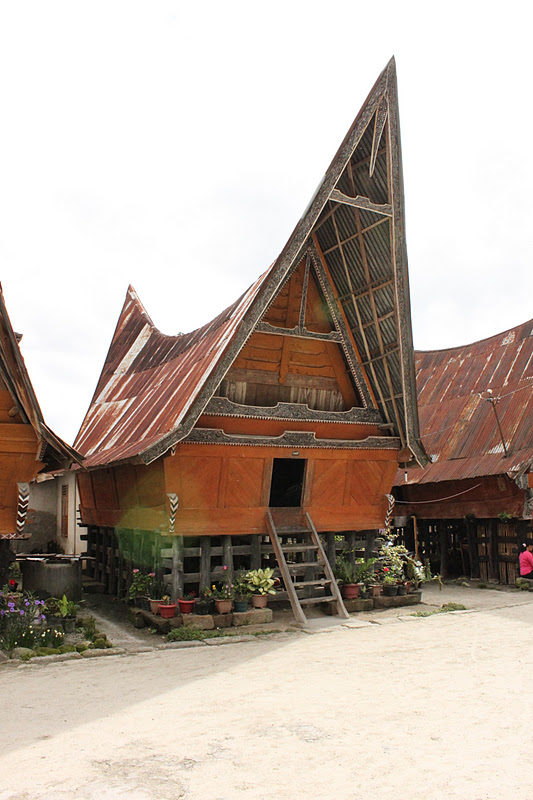
Once you arrive in the village you see a row of old houses (below) that are still used today.  Beyond them is the Banyan tree and at its base the Stone Chair of King Siallagan.  Beyond that is a public viewing area where you could see the condemned being tortured, trussed, carved, whipped, cut and covered in lemon and garlic
A traditional Batak House that is lived in today.
Ambarita Village, Samosir Island, Sumatra, Indonesia

Notice on the house above the rusted roof with large peaks on each end.  The front peak is always higher than the back.  The living floor was generally raised off the ground for protection and the ladder withdrawn at night.  Some houses had lofts as a second story.  Underneath the house would be used to keep animals and other supplies.  Sometimes even as a prison.  The houses were decorated with cravings in the Batak traditional colors of Red, White and Black.

Stone Monuements at Ambarita Village
Samosir Island, Sumatra, Indonesia
The story of King Siallagan and his "Court" is quite fascinating.  The Batak people of have a history of ritualistic cannibalism.  Ambarita and the Stone Chairs were the execution spot of the King as well as the place were all important judicial and village matters where taken care of. These megalithic stone chairs are over 300 years old and arranged in a circle.  There is also a large "beheading" chopping block.

One of the Stone Chairs of King Siallagan.
Ambarita, Samosir Island, Sumatra, Indonesia.
A large Banyan tree with an amazing root system.
Look closely and see if you see anything strange.
Ambarita Village, Samosir Island, Sumatra, Indonesia
A face in the wall.
Ambarita Village, Samosir Island, Sumatra, Indonesia
Another bonehouse or tugu
Ambarita Village, Samosir Island, Sumatra, Indonesia

From Wikipedia re Batak Cannibalism:

Ritual Cannibalism is well documented among Batak people, performed in order to strengthen the eater's tendi. In particular, the blood, heart, palms and soles of the feet were seen as rich in tendi.

Marco Polo passed on this description told to him:

"They suffocate him. And when he is dead they have him cooked, and gather together all the dead man's kin, and eat him. And I assure you they do suck the very bones till not a particle of marrow remains in them...And so they eat him up stump and rump. And when they have thus eaten him they collect his bones and put them in fine chests, and carry them away, and place them in caverns among the mountains where no beast nor other creature can get at them. And you must know also that if they take prisoner a man of another country, and he cannot pay a ransom in coin, they kill him and eat him straightway.
Oscar von Kessel visited Silindung in the 1840s and in 1844 was probably the first European to observe a Batak cannibalistic ritual in which a convicted adulterer was eaten alive. Interestingly, his description parallels that of Marsden in some important respects, however von Kessel states that cannibalism was regarded by the Batak as a judicial act and its application was restricted to very narrowly defined infringements of the law including theft, adultery, spying or treason. Salt, red pepper and lemons had to be provided by the relatives of the victim as a sign that they accepted the verdict of the community and were not thinking of revenge.


Ambarita Village, Samosir Island, Sumatra, Indonesia


Traditional Batak House
I'm not sure who has the sense of humor in Ambarita Village, but this was referred to as an eggplant.

More from Samosir Island continued in the next post .....

If you would like to visit Ambarita and Samosir Island,
then contact Adventures Abroad at 1800 665 3998
Quote code AANK for a special discount.

 
Pretty Nifty "truck" ,
Ambarita, Samosir Island, Sumatra, Indonesia